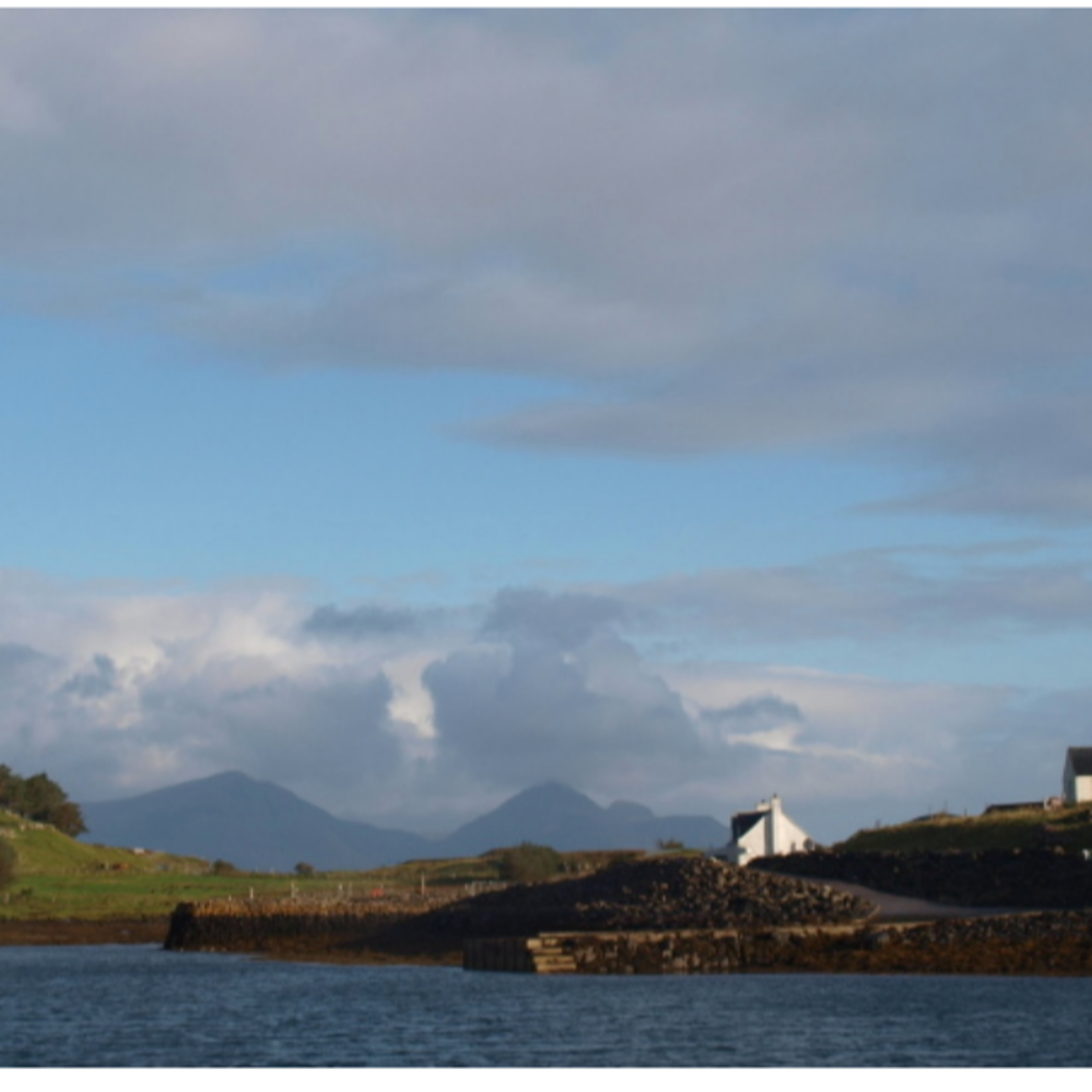
The south anchorage on The Isle of Muck is the easy one, even easier since it was buoyed making the old leading line involving the plantation on the skyline redundant. The 2004 roll-on roll-off ferry pier is rather large and lumpish, but it does allow visitors to be landed more safely, and for livestock to be moved around without so much hassle as was the case with the old flit boat. So although the anchorage is not as pretty as it once was, and there can be swell, it retains its charm, as does the whole island, very much so. But Muck is still on the edge of the world. There has never been a post office or shop, or doctor. There was no telephone until 1956, and direct mail didn't arrive until 1965, 24/7 electricity not until 2013 (powered by wind, solar panels and a back-up diesel generator).
The whole island is extremely pleasant, organised and well farmed, probably because it has been in the careful and loving hands of the MacEwan family since 1896. You can see that so clearly in the charming but somewhat sad BBC documentary about Lawrence MacEwan who died in 2022. Muck has been spared the chaos of the fast-changing ownership of Eigg at the end of the last century, and the degradation of Rum by the Edwardian nouveau riche from Northern England. Nowadays Muck has a population of about 40. At its height in the early 19th century it was in the 300s, before the people were 'cleared' in 1828 and set sail from Tobermory to the St Lawrence.
Just up from the pier is the delightful tea room crammed with interesting bits and pieces, and serving home-made scones, buns and so on. Come to think of it, these things could hardly not be home-made given the island's isolation. And they usually do evening meals at the weekend (07470 711799). There are (or were) a couple of craft shops nearby, presumably reflecting the number of tourists who can come across from Arisaig on the Shearwater for a day trip. Just up the hill you can buy eggs, crab and lobster when available (maybe not anymore). Also there is a burial ground, and it is perhaps a surprise to find a war grave there, and further up an abandoned village — A'chille.
Do walk across the island, the views of Rum and Eigg are excellent. On the north side you will find Gallanach Lodge where you can get what sounds like excellent dinner, bed and breakfast. And you can get dinner as a non-resident if they have room, call beforehand in good time (ph 01687 462365). Various prehistoric remains could be taken in during a walk round the island. The two burial cairns on Aird nan Uan bounding the west side of the north anchorage, and the Iron Age fort above the south anchorage, Caisteal an Dùin Bhain.
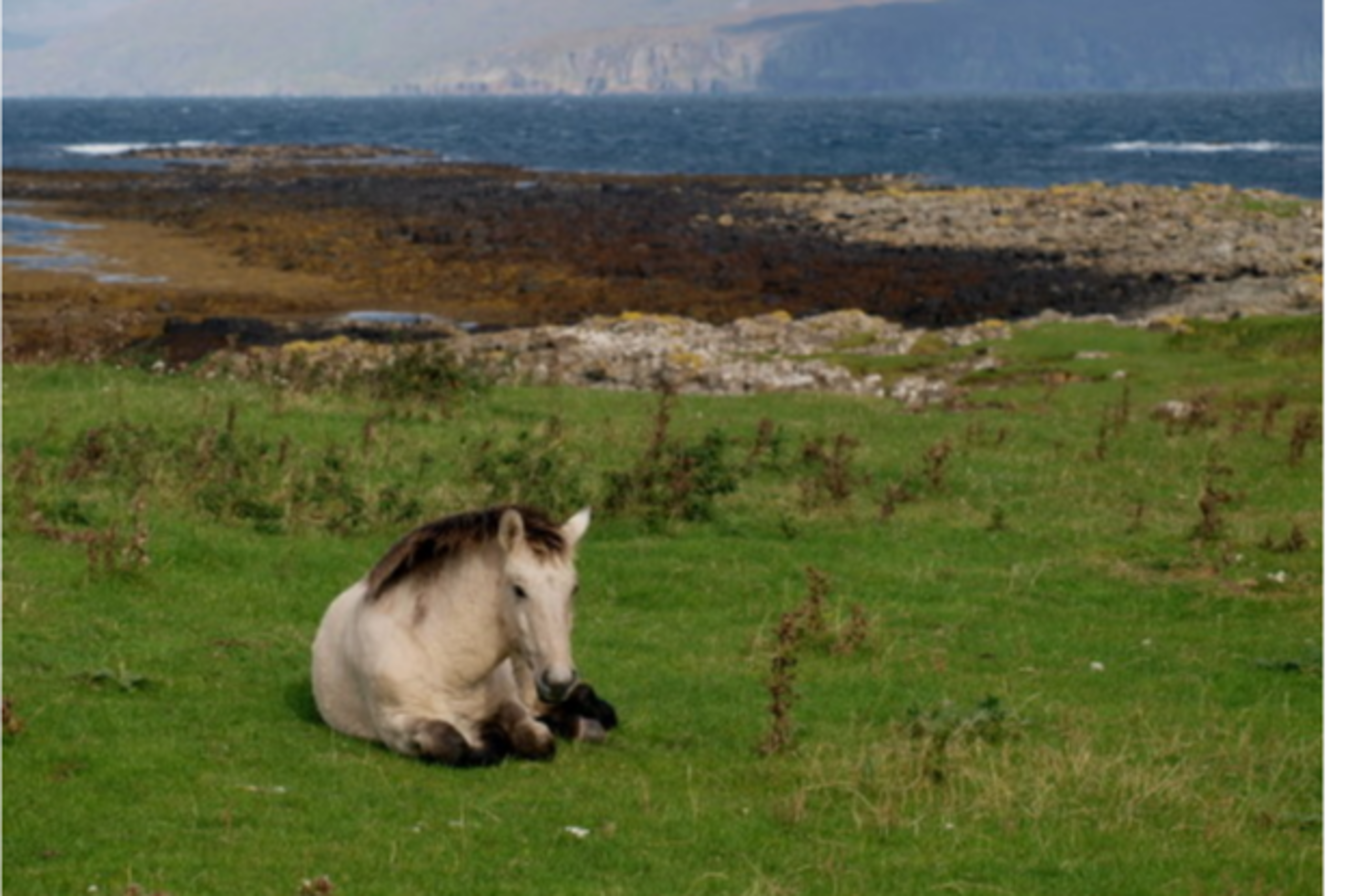
The north anchorage is altogether much more sporting with a leading line requiring the identification of the correct barn of two, a wall which looks more like a cliff, and with little room to spare with the underwater reef to port. Moreover, the chartplotter does not seem to get the entrance line quite right. Beware! But, as ever, it is not as bad as it sounds in the Sailing Directions, the Antares chart takes all the stress away, and the views of Eigg and Rum from the anchorage, and the wildlife, are terrific. There are always seals around, and the usual selection of seabirds, with terns and oystercatchers making the most noise. Ashore, just to the east of the lovely beach (ideal for small children who are prepared to share with the cows and horses) is a narrow gut between two reefs with an old jetty and some rail tracks (what were those for I wonder?). Along the reef is a good spot for seals. And of course one can always walk across the island to the tearoom, maybe half-an-hour, if that.
Finally, the name. Not muck as in dirt, but Gaelic for pig. Why pig? I don't know. However, it was not a name that was liked, at least not in the 18th century: Samuel Johnson noted "It is commonly called Muck, which the proprietor not liking, has endeavoured, without effect, to change to Monk" (A Journey to the Western Islands of Scotland. Samuel Johnson, 1775, Ed RW Chapman, Oxford University Press, 1970 ). Boswell his companion added: "It was somewhat droll to hear the Laird called by his title. Muck would have sounded ill; so he (that is the laird) was called Isle of Muck, which went off with great readiness" (The Journal of a Tour to the Hebrides with Samuel Johnson. James Boswell, 1785, Ed RW Chapman, Oxford University Press, 1970). If you want to know more of Muck, read Polly Pullar's excellent 'A Drop in the Ocean, Lawrence MacEwan and the Isle of Muck', Birlinn, 2014.