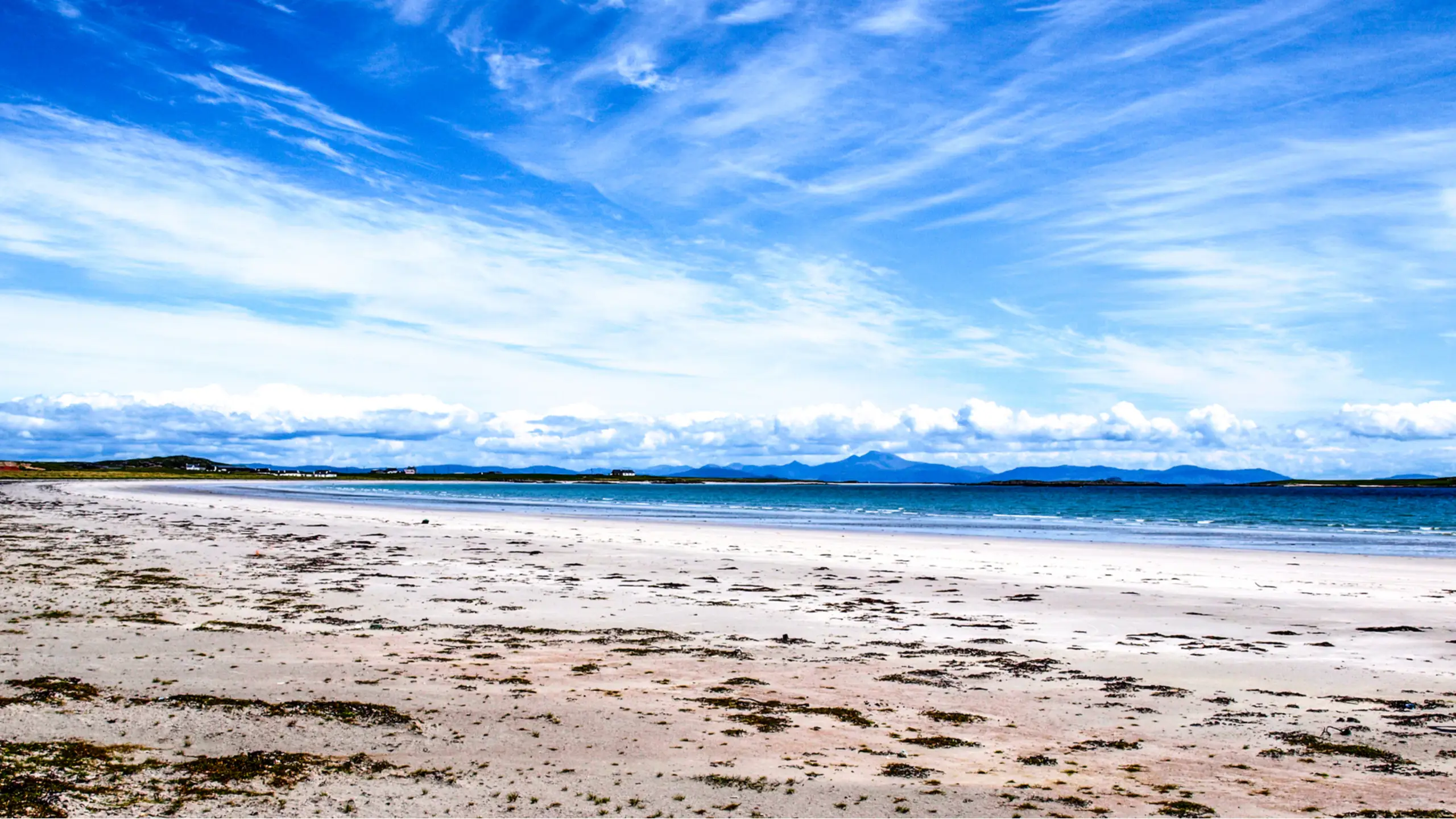
Frank Cowper got it wrong in the late 19th century when he wrote: "As for Tiree and Coll, the less said about them the better" (Sailing Tours: The Yachtsman's Guide to the Cruising Waters of the English and Adjacent Coasts, Part V, The West Coasts of Scotland, the Orkneys, and the west coast of the North sea. Frank Cowper, Upcott Gill, London, 1896). However, as John Knox had found during his tour 100 years earlier, the problem like Cowper's was the lack of safe anchorages which to some extent is still true today, even with our engines and chartplotters (A Tour through the Highlands of Scotland and the Hebride Isles in 1786. John Knox, James Thin, Edinburgh, 1975). Mind you it was to the safety of Loch Eatharna, then known as Lochiern and where Arinagour now is, that Boswell and Johnson got blown during that dark and stormy night in 1773, and survived to tell the tale (A Journey to the Western Islands of Scotland. Samuel Johnson, 1775, Ed RW Chapman, Oxford University Press, 1970).
Every island has its own character and Coll's is undoubtedly Outer Hebridean (even though it is firmly part of the Inner Hebrides) — similar forbidding eastern coastline, and similar delightful beaches on the western coastline. It has a population of around 160, with about 10 in the primary school. Something like a third of the houses are holiday or second homes these days. Not well known, Coll too had a 'Whisky Galore' 2nd World War moment when the Nevada ran aground in Struan Bay northeast of Rubha Mor — quite an easy walk from the Sorisdale anchorage — and deposited thousands of cigarettes and other goodies for the islanders to squirrel away. In 2013 the island was awarded Dark-Sky status, although you would have to be sailing here early or late in the season to appreciate it.
Coll is probably best known outside Scotland as the home of Project Trust which sends young people, mostly in their gap year between school and university, all over the world to do good works (but in 2025 they decided to sell their properties and move away, leaving something of an economic gap on the island). And inside Scotland as once a home of Mairi Hedderwick who wrote the lovely Katie Morag children's stories. She also wrote a rather nice account of how most of Coll was once owned by a family who latterly farmed it and eventually by 1991 had sold most of their estate to the islanders, the RSPB and incomers (The Last Laird of Coll. Mairi Hedderwick, Birlinn, Edinburgh, 2011).
Tiree, the final inhabited Hebridean island I got round to sailing to, is completely different to Coll, or anywhere else in Scotland. It reminds me more of Connemara — flat with occasional mountains poking up in the distance, although unlike Ireland the mountains here are on different land masses (Jura, Mull, Rum and Skye). Tiree is so flat and low that global warming and a slight rise in sea level could do for it unless it is saved by the gradual upwards movement of the earth's crust; imagine the chart in a hundred years, no Tiree just a couple of rocks — Sgeir Hough and Sgeir Hynish.
The island is not much visited by boaties, I guess because there is no all-weather anchorage. Indeed, the main one at Gott Bay is exposed to the south and east, and not all that attractive. However, take a windsurfer — Tiree is famous for wind and waves (and sunshine hours in the summer). Strangely, given about 700 people live on Tiree (nearly 50% of the houses are second homes), there seems to be relatively less than on Coll in the way of cafés or pubs. Maybe nothing changes because even back in 1695 Martin Martin complained that "The ale that I had in the inn being too weak, I told my host of it, who promised to make it better" He didn't. (A Description of the Western Isles of Scotland, circa 1695. Martin Martin, Birlinn, Edinburgh, 1994). The Ceabhar Restaurant at Sandaig is rather far away from any anchorage although it certainly looks attractive.
Finally, an unlikely difference between the two islands, this time from Daniel Defoe: "The inhabitants are Protestants. They have a notion here, that Tyre-ty breeds more women than men, and Coll more men than women; so that they may people each other without the assistance of their neighbours" (from the 1761 edition of A Tour thro' that part of Britain called Scotland, originally by Daniel Defoe, later editions and additions by Samuel Richardson).