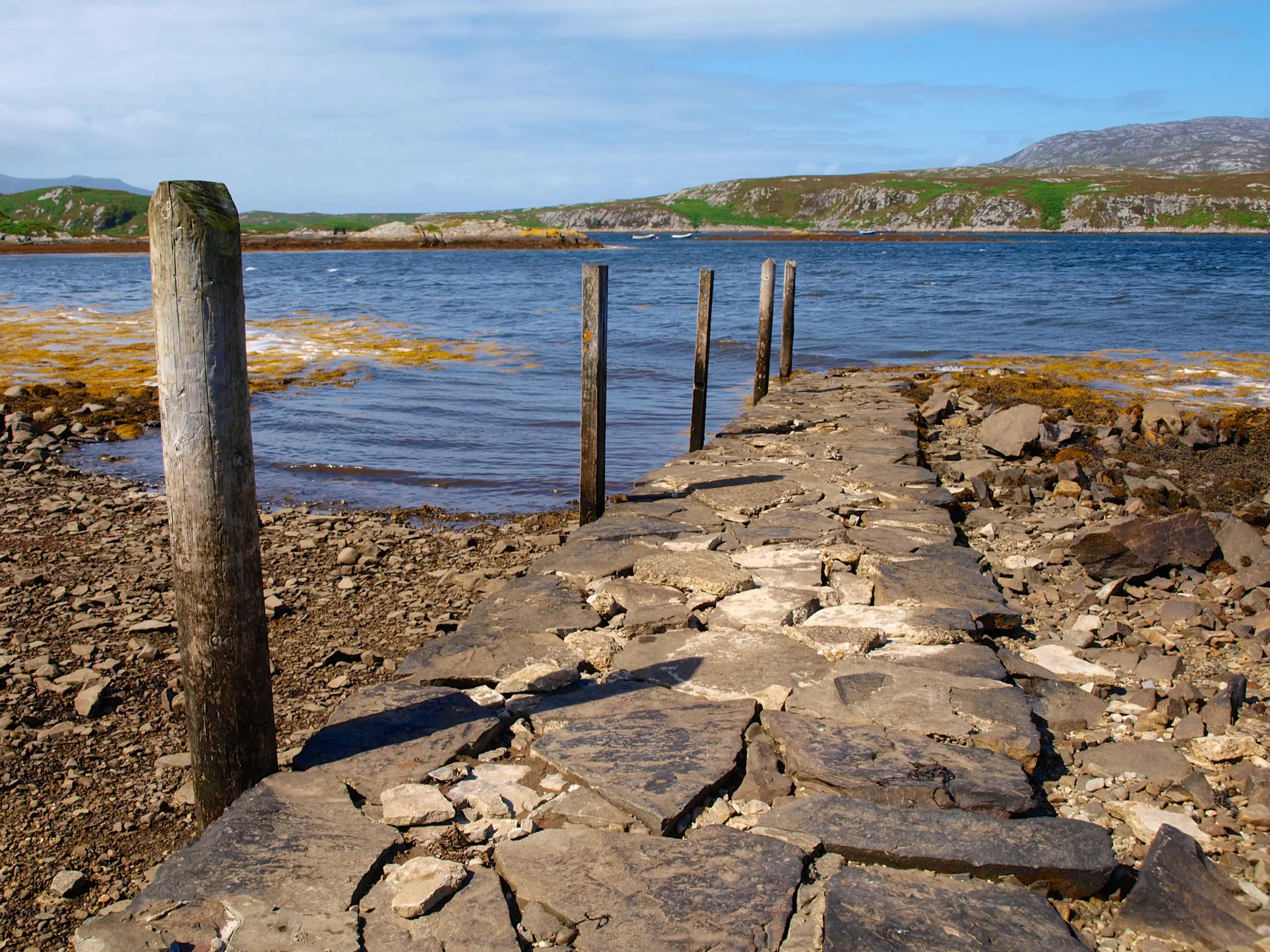
A wild place indeed! This loch stretches for miles across the most uninhabited part of Jura, almost cutting the island in two. Apart from a shooting lodge at Glenbatrick on the south shore, and a few bothies, there is no obvious habitation (apparently the lodge is a summer retreat for Viscount Astor who owns the estate). Just moorland and a large number of raised beaches, so characteristic of Jura west coast geology. On a bad day it is dire, but on a good day it is fabulous as a getting away from it all place.
In days past it was a bit of a no-no for boaties. In the 17th century Martin Martin wrote "it is not a harbour for vessels, or lesser boats, for it is altogether rocky" (A Description of the Western Isles of Scotland, circa 1695. Martin Martin, Birlinn, Edinburgh, 1994). Even in 1938 John McLintock considered "Loch Tarbert ... affords but little shelter, for its upper reaches are so rock-set as to be unnavigable, and lower down it is exposed to the west and tormented by fierce squalls from the hills" (West Coast Cruising. John McLintock, Blackie and Son, London and Glasgow, 1938). Indeed, in poor visibility it is all but impossible to make out the leading lines (placed by the legendary Blondie Hasler after the second world war). But now with a chartplotter it is much easier to find your way around, and even easier with Antares charts.
There is, I understand, a lunch stop on the Antares Charts at An Sàilean, a small bay just at the northern entrance to the loch. I mention this because there are caves a few minutes to the northwest (Corpach an t-Salean) near Ruantallain where dead bodies were once kept until the weather was clement enough to ferry them across to Oronsay for burial. Apparently the Gaelic 'corpach' may mean the field of corpses.
If there is another boat in the first anchorage, Cumhann Mor Bay, you can go on through the first narrows to find any number of good anchoring spots, and further again through the second narrows although I never have. If you get to the head of the loch without hitting anything, you will have done very well. Cowper seems to have managed it in the 19th century without an engine, although he is not absolutely specific on this point. Maybe he was boasting (Sailing Tours: The Yachtsman's Guide to the Cruising Waters of the English and Adjacent Coasts, Part V, The West Coasts of Scotland, the Orkneys, and the west coast of the North sea. Frank Cowper, Upcott Gill, London, 1896).
The loch is an attractive place spoilt only, said a friend, by 'the noise of a motor boat towing a small rowing boat containing the remains of two stags!' I don't think there is much to see or do ashore that you can't see from the boat, although there are beaches to sun yourself on — on a good day.