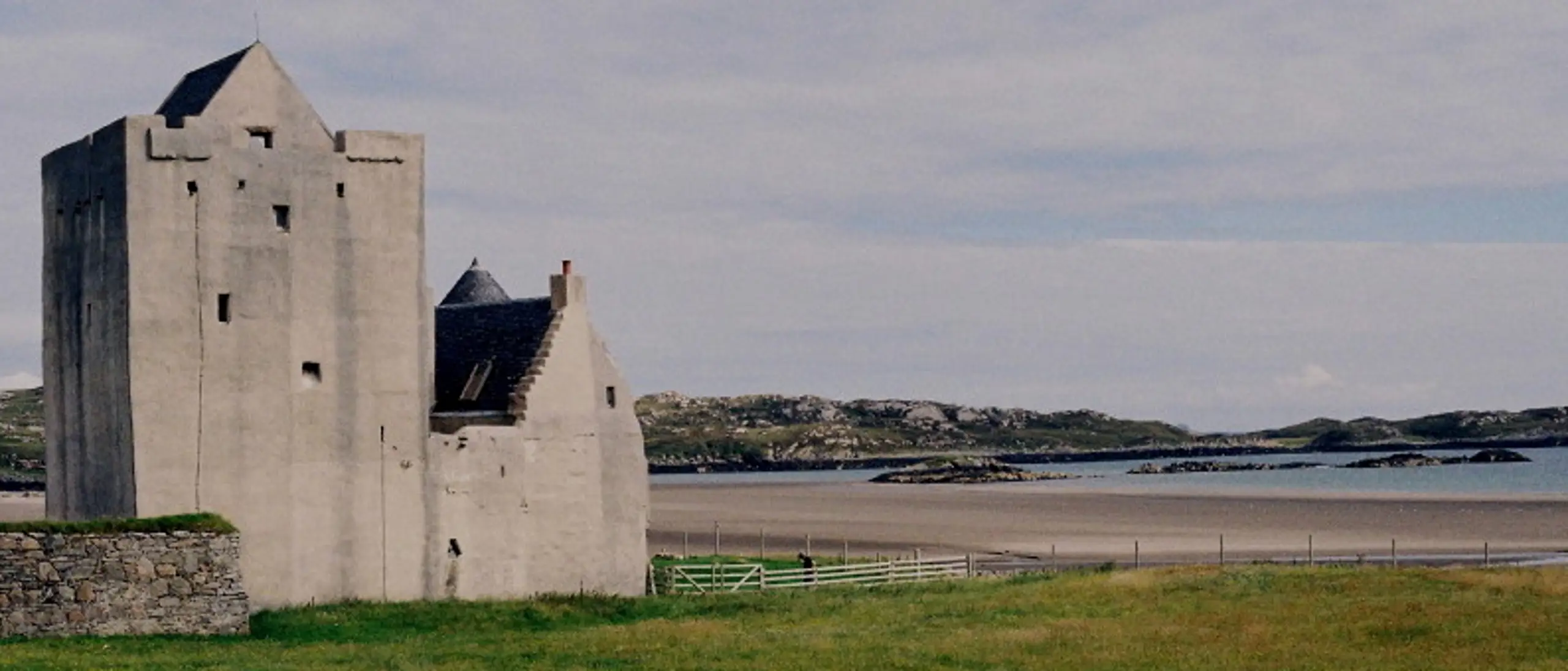
Another anchorage for when the wind is in the north, and very pleasant it is too although it is a bit of a row to get ashore, obviously more so at low tide when it would be a long walk carrying the dinghy. However, it is worth it to examine the three large stone buildings which is just about all there is, other than the fine beach and the birds. No trees either. Pretty bleak when the sun isn't shining, fabulous when it is.
First the old castle, once a ruin but restored in the late 20th century and privately owned by Nicholas and Lavinia Maclean-Bristol (founders of Project Trust). Indeed, the owners regard the small patch of grass between their fence and the foreshore as part of their 'garden' so don't settle down there amongst the sheep poo and spent cartridges. It is a strange looking castle, essentially a tower house with something of a curtain wall, all covered in very dull, but perhaps authentic, grey harling. Apparently there were originally no fireplaces, so it must have been hellish cold in winter. It was built by the MacLeans of Coll in the 15th century, altered in the late 16th and 17th centuries, but then abandoned in the 18th century when the MacLeans upgraded to an even stranger looking concoction next door, the 'new' castle below. Part of the strangeness of the old castle is that one is not used to seeing castles on Scottish beaches, they look better on rocky outcrops where they can be more easily defended. Indeed 'Pevsner' likens it to "a heavily iced cake planted on the machair at the head of Loch Breacachadh"! (The Buildings of Scotland, Argyll and Bute. Frank Arneil Walker, Penguin Books, London, 1992).
New Breacachadh Castle, just up the hill, was originally an 18th century mansion with wings, dismissed as a "tradesman's box" by Dr Johnson in 1773 (A Journey to the Western Islands of Scotland. Samuel Johnson, 1775, Ed RW Chapman, Oxford University Press, 1970). It was then made ridiculous in the 19th century by the addition of a fourth floor with crenelated parapets and round corner turrets. It had been falling to bits but in 2016 it was up for sale at £450 000, and now it seems to be a self- catering establishment. It is hard not to wish the whole lot couldn't just be taken apart and the stone used for something far nicer, but you never know it may turn out fine. Fine like, for example, by far the most attractive of the three buildings, the late 18th century farm steading, a delightful collection of buildings restored by I believe a group of five co-owners. A charming addition and complement to the landscape, not a foolish erection like the new castle.
You will find the birds — corncrakes etc — on the RSPB reserve just to the northwest of the anchorage.